
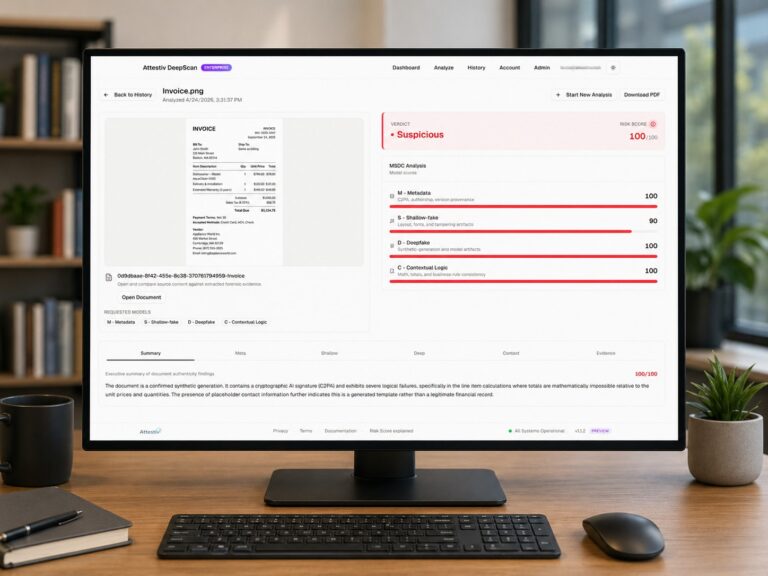

Validate Financial Services Documents and Media Before Risk Decisions Are Made
Attestiv helps financial services teams validate submitted documents, screenshots, photos, audio, and video using AI analysis, configurable rules, and business-data checks.
Financial services workflows increasingly depend on digital files submitted by customers, applicants, merchants, counterparties, and third parties. These workflows often depend on files that must match customer, account, transaction, merchant, application, or compliance records before a decision can be made. Those files may include statements, screenshots, invoices, identity documents, application materials, dispute support, business records, audio, video, and other supporting documents.
Some files may be AI-generated. Others may be altered, reused, incomplete, inconsistent, or mismatched against customer, account, transaction, application, or compliance data.
Attestiv helps teams validate submitted files before they drive onboarding, fraud, risk, compliance, lending, dispute, or operational decisions.
Request a financial services validation workflow review
Trusted by organizations working to validate digital submissions before critical decisions are made.
Our partnership with Attestiv gives our clients a powerful tool to validate digital media ... before critical decisions are made
Rob Marinello
Sr Dir, ReSource ProFinancial services fraud is increasingly a submitted file problem
Digital financial workflows are faster and more automated than ever. But the files supporting those workflows still need to be trusted.
Submitted files can create risk when they are:
- AI-generated or synthetic
- Altered or manipulated
- Reused across accounts, applications, or cases
- Missing required information
- Inconsistent with customer, account, transaction, or application data
- Submitted outside expected timeframes
- Suspicious enough to require fraud, risk, or compliance review
The question is not only whether a file is fake.
The more practical question is: Can this file be trusted for this decision?
Use cases across financial services workflows
Digital onboarding and KYC / KYB
Validate identity-related documents, business records, screenshots, and supporting files submitted during account opening, customer onboarding, merchant onboarding, or business verification.
Fraud and risk operations
Analyze suspicious files, identify inconsistencies, detect reuse or manipulation indicators, and route higher-risk submissions for review.
Lending and applications
Validate application materials, income or asset documents, statements, invoices, supporting photos, and other files against application data and workflow-specific rules.
Disputes and investigations
Review screenshots, statements, transaction support, audio, video, and other submitted files to determine whether they align with the disputed event or supporting records.
Compliance operations
Support review of documents and media used in regulated workflows by applying consistent checks, required-file rules, and escalation criteria.
Payments and merchant workflows
Validate merchant-submitted documents, transaction support, business records, invoices, screenshots, and other files used in onboarding, risk review, or dispute workflows.
Validate submitted documents and media across file types
Documents
PDFs, forms, statements, invoices, receipts, application materials, business records, identity-related documents, and supporting documentation.
Screenshots and images
Screenshots, photos, account images, transaction images, uploaded supporting files, and other visual submissions.
Audio
Call recordings, voice submissions, dispute support, or other audio files that may require synthetic or suspicious signal review.
Video
Submitted videos, recorded interactions, dispute materials, or other visual media used to support decisions or investigations.
AI analysis, configurable rules, and business-data checks
Attestiv helps financial services teams evaluate submitted files using a combination of analysis signals and workflow-specific validation logic.
Capabilities include:
- Detect signs of editing, tampering, manipulation, or synthetic content
- Review metadata, timing, format, and file-level inconsistencies
- Identify reused, duplicated, or suspiciously similar files
- Compare submitted files against customer, account, transaction, application, or business data
- Apply configurable rules, thresholds, tolerances, and escalation criteria
- Route files to pass, flag, request more information, or escalate for review
- Support consistent validation across high-volume workflows
Decide what should pass, be flagged, or be escalated
The value of validation is not just identifying suspicious files. It is helping teams decide what happens next.
Attestiv can help financial services teams define workflow outcomes such as:
Pass
The file meets required validation checks and can continue through the workflow.
Flag
The file has one or more issues that should be reviewed, corrected, or supplemented.
Escalate
The file presents higher-risk signals and should be routed to fraud, risk, compliance, or investigations.
Request more information
The file is incomplete, inconsistent, or missing required support.
More than deepfake detection
Deepfake and synthetic media detection are important, but financial services teams need broader validation.
A submitted file may not be AI-generated and still be problematic. It may be real but reused, altered, incomplete, inconsistent, outside policy, or mismatched against the relevant business record.
Attestiv helps validate submitted files in context, combining AI analysis with the rules and data that matter to the workflow.
Questions Attestiv can help answer
- Does the submitted document show signs of tampering or manipulation?
- Has this file appeared in another application, account, dispute, or case?
- Does the screenshot or statement align with transaction data?
- Does the application document match the information provided by the customer?
- Is required supporting documentation missing?
- Does the file contain metadata or formatting inconsistencies?
- Does the submitted media appear synthetic or suspicious?
- Should this submission pass, be flagged, or be escalated?
Map validation controls to your financial services workflow
Whether your team reviews onboarding documents, application materials, dispute files, transaction support, merchant records, or fraud submissions, Attestiv can help identify where automated validation can reduce manual review and improve consistency.
FAQ
Is Attestiv only for deepfake detection?
No. Attestiv supports broader submitted file validation across documents, images, audio, and video. Deepfake and synthetic media detection are important signals, but financial services workflows often require additional checks against business data and workflow rules.
What types of financial services workflows can Attestiv support?
Attestiv can support onboarding, KYC/KYB, lending, fraud review, disputes, compliance operations, merchant review, and other document or media-heavy workflows.
Can Attestiv validate files against business data?
Yes. Attestiv can support validation checks against customer, account, transaction, application, merchant, or other business data sources depending on the workflow.
Does Attestiv replace human review?
No. Attestiv helps pre-screen files, flag suspicious or inconsistent submissions, and route exceptions for review so human teams can focus where they are most needed.
LEARN MORE

AI Content Detection Is a Signal. Validation Is the Workflow.
AI-generated content detection is quickly becoming an important enterprise control, but as part of a broader set of workflows to validate content suitability and make decisions.

Attestiv Included in Google Announcement on AI Content Detection and Media Transparency
Attestiv is proud to be included among the trusted partners supporting this effort.

How to Build a Validation Workflow for Submitted Files
Organizations increasingly rely on submitted files to make important business decisions. File validation workflows enable automation file processing efficiencies without risk and exposure.