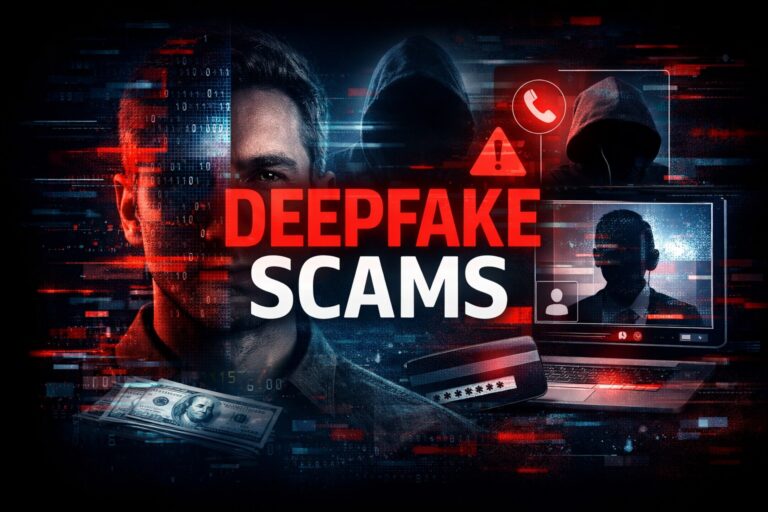
Deepfakes have crossed the line from “edge case” to an operational fraud tool that can be produced cheaply, quickly, and convincingly. A recent Guardian report describes deepfake fraud happening “on an industrial scale,” enabled by easy-to-use tools that can impersonate faces and voices and target victims with alarming precision.
At the same time, a Fortune article (citing Experian’s 2026 fraud forecast) warns that AI-powered scams are poised to surge further, expanding beyond consumer scams into areas like hiring and business processes that traditionally relied on human judgment.
What’s changing isn’t just the quality of fakes, it’s the economics:
Lower cost to create convincing impersonations
Higher volume (scalable campaigns, not one-offs)
More targeting (personalized scripts, contextual cues, emotional manipulation)
The developing threats that organizations should plan for now
1) Deepfake-driven “employment fraud” and hiring pipeline attacks
One of the most concerning emerging use cases involved deepfakes in HR and hiring: synthetic applicants making it through video interviews, getting onboarded, and gaining access to internal systems, data, and financial processes. The Guardian highlights real incidents where organizations nearly hired AI-generated candidates, underscoring how close this is to becoming routine.
The risk: hiring is an identity gateway. If a bad actor passes as “real,” they can become an insider—often with legitimate credentials.
2) Voice impersonation in call centers, account takeovers, and “urgent request” scams
Deepfake voice cloning is already effective enough to power highly believable social-engineering: “relative in distress,” “CEO needs this done now,” “support agent reset my account,” and more. The Guardian points to deepfake voice as a major driver of successful scams and rising incident reports.
The risk: the human voice has historically been a trust signal. That assumption is rapidly breaking.
3) Synthetic video on live calls for payment fraud and authority impersonation
Cases involving fake video calls used to defraud organizations, including a finance officer duped into transferring large sums after a deepfake video meeting.
The risk: video used to be a more secure channel than email. Now it can be forged at scale.
4) “Trust collapse” in digital evidence and media
A quieter but equally dangerous impact: the erosion of confidence in photos, videos, and recordings—especially in high-stakes contexts like insurance claims, compliance, HR disputes, newsrooms, and legal proceedings. This comes along with a broader societal concern that deepfakes can undermine trust in institutions and digital communication.
What organizations should do next: a practical defense model
The most effective response isn’t a single detector. It’s a layered verification strategy that adds friction only when risk is high:
Detect: score content for signs of synthesis (voice/video/image)
Decide: apply policy thresholds (allow, warn, step-up, block, queue for review)
Prove: wherever possible, generate verifiable provenance for real media (so “real” is easy to demonstrate)
Operationalize: integrate into workflows (HR systems, call center tools, claims platforms, SOC/SIEM)
Deployable Use Cases
Here are concrete solutions that can address the threats described above:
A) Hiring & onboarding authenticity
Video interview authenticity checks (real-time or post-call scoring)
Active liveness challenges designed to defeat replay and deepfake pipelines
Step-up verification for high-risk candidates before issuing credentials
Mapped to the rise in deepfake-driven hiring threats discussed in the reporting.
B) Voice & call integrity for fraud operations
Deepfake voice detection on inbound/outbound calls
Account takeover / wire fraud step-up when risk is high
Agent workflows that enforce safe out-of-band verification
C) Verified capture and chain-of-custody for evidence
Capture-time sealing (tamper-evident proof that a photo/video hasn’t been altered)
Verification receipts that can be shared with third parties (auditors, adjusters, courts, partners)
Provenance support for news/media, insurance, compliance, and investigations
D) Fraud at scale: automation + human-in-the-loop (HITL)
Unified authenticity risk score across media, metadata, and context
Queues and review tooling for “only the risky cases”
Integrations into existing fraud/claims/HR systems so results drive action, not just reports
Closing: the new baseline for trust
Deepfakes aren’t just improving—they’re becoming standard operating procedure for fraud. The organizations that respond fastest will be the ones that treat authenticity like cybersecurity: continuous, layered, and integrated into business processes, rather than an occasional forensic exercise.
Contact us to learn how we can help with a multi-pronged strategy to fight deepfake threats.